



Reading time: 6 minutes
For decades, the hotel industry has been powered by systems that operated independently: reserve engines, PMS, RMS, CRM, channels and data that barely understood each other. Today, that fragmentation comes to an end. A new stage begins where artificial intelligence not only recommends, but also understands, connects and acts. We have created a new layer of infrastructure for global tourism: a Booking Engine prepared to operate with AI agents, connecting PMS, RMS, CRM and direct channels in real time, and redefining how hotels connect with the next generation of travelers who discover and book through smart assistants.
The new age of hotel discovery: from search to intelligent dialogue
Today we mark a milestone in digital hotels: we have developed the first reservation engine with native integration MCP (Model Context Protocol), allowing any artificial intelligence model -Claude, ChatGPT, Grok, Gemini, Perplexity or other LLMS- You can directly access our full API through conversational language.
The magic of MCP lies in unification: all this fragmented information—which would normally require 5-10 different sources—is presented in a cohesive, contextual, and conversational way. The traveler does not perceive separate systems; Perceive a smart assistant who “knows” your hotel and the customer journey in depth.
For more than two decades, the hotel discovery has followed a predictable pattern: the user introduces search parameters (destination, dates, filters), the system returns results ordered by relevance, and the traveler compares options manually. This model has been effective, but it is fundamentally transactional and unidirectional.
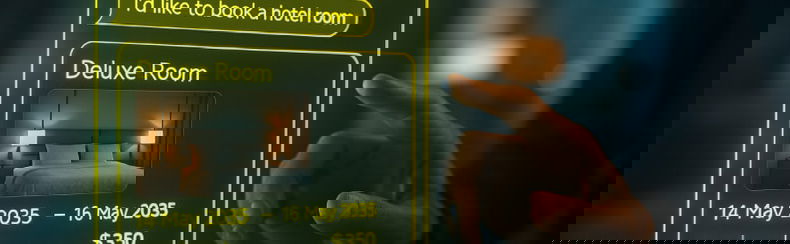
For the first time, smart assistants can Talk directly to the reserve engines. Check availability for real, show updated rates, read reviews, and even confirm reservations... all in a natural conversation. No forms, no steps, no friction.
You: "I need a hotel in Ibiza for this weekend, near the airport."
IA: [Search for real availability] «I have found 3 options near Ibiza airport: Hotel Torre del Mar has a double room with sea views at €145, Hotel Garbi offers a junior suite at €158, and Migjorn Suites & Spa has a suite superior to €189»
You: “I am interested in the Migjorn, does it include breakfast?”
IA: [See details of the rate] «Yes, the Superior Suite includes a breakfast buffet and access to the spa. Do I confirm the reservation?
You: "Can you give me a summary of their reviews?"
IA: [Check the reviews] “Of course, in general, it is a very well valued hotel for its central location, modern facilities and friendly staff”
You: "Perfect, reserve it."
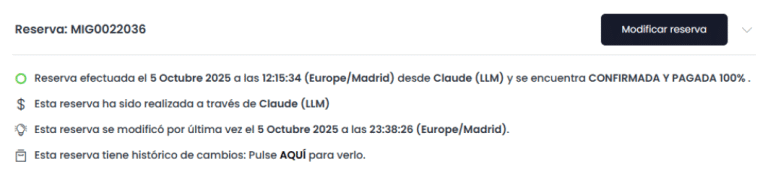
IA: [Create the reservation] «Confirmed. Book MIG0022036 at Migjorn Suites & Spa for October 11-12. Check-in from 3pm. I sent you the voucher by email.
MCP, the common language of artificial intelligence
As we saw in a post (Link) Previous, the Model Context Protocol is the new standard created by Anthropic that allows the IAS to converse directly with any connected system.
Until recently, AI assistants were brilliant conversationalists but unable to execute actual actions. They could recommend the best hotel in Ibiza, but they couldn't reserve it for you. We have removed that barrier, allowing LLMs and AI agents, and in real time:
- Consultation of the information of your establishment: Instant access to up-to-date data about your hotel or chain: Facilities description, services available (spa, restaurant, car park), property policies (pet-friendly, accessibility, sustainability), room amenities, and differential characteristics of your property. All without the need to browse multiple pages or menus.
- Availability and dynamic price management: Consultation of updated prices, availability by type of room, rates according to length of stay, current special offers, advance booking discounts, promotional packages, and specific cancellation policies by rate. The AI accesses the booking engine directly to offer accurate and up-to-date commercial information to the second.
- Unified geographic and reputational context Integration of multi-platform reviews (TripAdvisor, Google, Booking), accurate geographic information and nearby points of interest, plans and activities available in the area, relevant local events, transportation and connectivity options, and specific service ratings. All consolidated in a single contextual response.
- Agentic transactional execution The most disruptive capacity: Execute complete operations without human intermediation. Create confirmed reservations, modify dates or type of room, apply promotional codes, process secure payments, send automated confirmations, and manage special requests (cot, extra bed, early check-in). All through natural conversation, no forms, no clicks, no friction.
In other words: the conversation turns into action.
Preparing the architecture of the future: Ecosystems interconnected on unified data
The traditional model of hotel integration is vertical and fragmented:
- The PMS Stores information about reservations, guest data, room inventory, accounting records, check-in and check-out details, etc.
- The CRM Maintains customer preferences, stay history and loyalty programs
- The Channel Manager Sync inventory with OTAs using specific feeds and proprietary formats
- The Revenue Management System Analyze prices and competition in your own database
- The Reviews and ratings They are fragmented between TripAdvisor, Google, Booking, social networks and their own web
- The Tourist plans and activities They are spread across third-party websites, travel blogs, and experience platforms
- The billing system Operates independently with your own numbering and structure
- The Information of amenities and services (spa, restaurant, parking) is duplicated on multiple platforms with inconsistent descriptions
- The Personnel data and shifts reside in offline HR systems with operations
As you can see, each system speaks its own “language”, maintains its own version of what happens, and requires costly and fragile point-to-point integrations. This model is unsustainable in a world where AI needs transversal, contextual and real-time access to unified information.
MCP, more than a technical protocol, deals with a statement of principles on how the future of AI should be built in the tourism sector: open, standardized, collaborative and focused on empowering developers, companies and end users, and not locking them in proprietary ecosystems.
A really different technological transformation
Unlike previous technological revolutions (internet, search engines, responsive design, mobile apps, metasearch), This is not resolved with a new interface. It is not enough to have a faster website or a better designed app. The underlying infrastructure of how we expose, structure and connect hotel information must change radically.
And here is the critical point that many in the industry still do not understand: Far from developing new products and functionalities, the near future is interconnected AI ecosystems. It is not about choosing between innovating in product or preparing for AI. It is about understanding that product innovation now requires A radical change of mentality and a standardized data infrastructure prepared for AI.
Why at NeoBookings we are leading the transformation of hotel technology
And here's the great news: Thanks to the Neobookings booking engine with native MCP integration, a fundamental piece of this ecosystem is ready for the supreme connectivity revolution designed for LLMs.. While the sector still debates the relevance of the conversational AI, we have already built the infrastructure that allows any LLM -Claude, ChatGPT, Gemini or the one that comes tomorrow- to consult real availability, manage reservations, modify rates, access cancellation policies and Operate with real-time inventory data, all through natural conversation.
Hotels that work with neobookings do not need to wait for "the future of AI to come." They already have a critical piece of their ready and operational infrastructure.
Because in a world where AI is the new intermediary between the intention of the traveler and the hotel offer, they will gain those whose data is more accessible, richer and more intelligible for the systems that make the recommendation decisions. And with Neobookings, that competitive advantage is no longer an aspiration. It is a technical reality displayed and functional.
Being the first is no coincidence. It requires vision to understand where the industry is going, a solid technological architecture, commitment to open standards instead of closed spaces, and constant innovation, 24/7.
We are building the base on which it will rise The tourism of tomorrow: Open, connected and conversational.
a personal note:
I want to especially thank Dario Amodei for the extraordinary work he has led since his departure from OpenAI in 2021 to found Anthropic. His vision of bringing artificial intelligence closer to companies in a more ethical, transparent and truly revolutionary way has been inspiring.
And yes, I admit it without hesitation: I am a declared fan of Claude. Work with tools that are not only powerful, but are designed with a philosophy of respect for the user and the ecosystem.
If you want us to talk about the technological future of your hotel or chain, write us. The time is now.