




Reading time: 6 minutes
What campaigns should never stop
Before talking about seasons, it is convenient to be clear about which campaigns should never stop.
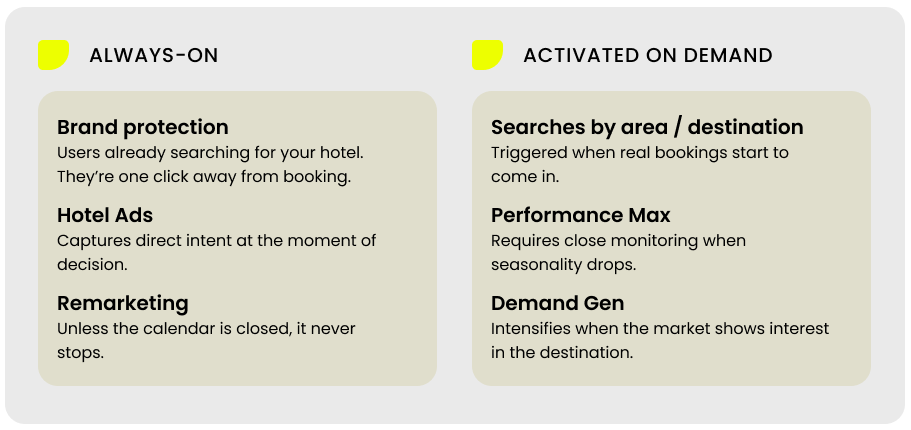
Hotel Ads branding and booking links work with users who already know where they want to stay and are just one click away from booking. Turning them off is losing customers who were already convinced. The same goes for remarketing: unless the hotel has a closed calendar, keeping it active always makes sense.
Another story is the search campaigns by zone, Performance Max or Demand Gen. These are progressively activated, depending on when real demand begins to enter and how the market behaves. There is no fixed date: you have to read the signs
When to scale and when to contain the investment
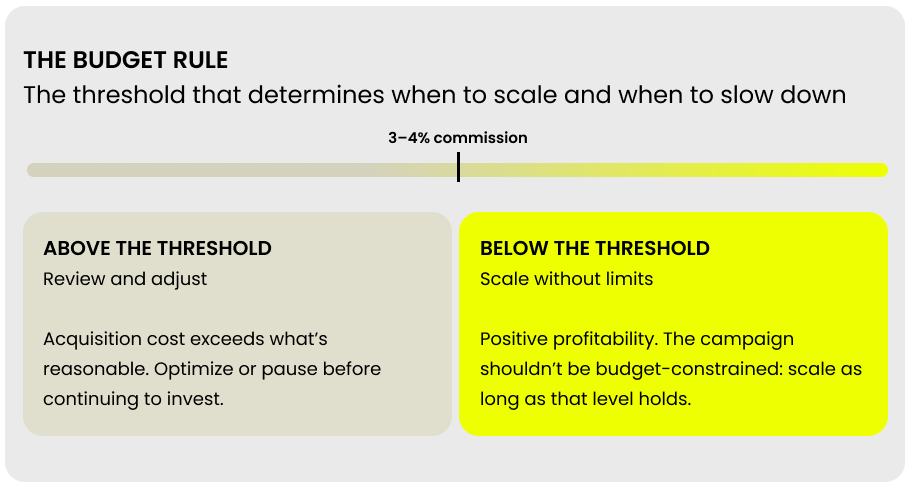
There is a clear rule to manage investment in hotel campaigns: if a campaign generates a return equivalent to a commission less than 3-4%, it should not be limited by budget. In that scenario, the right decision is to scale while maintaining that level of profitability.
At the demand peaks, it also makes sense to allocate part of the budget to capture cold traffic, even if the acquisition cost is somewhat higher. These campaigns have a notorious effect that many hotels underestimate: they present the property to users who have not yet decided where to stay.
Many customers focus on cost per channel or direct sales increase. They are useful metrics, but secondary. Profitability is the North all year round.
In addition, it is advisable to analyze impressions and visualizations by country of origin. Knowing how the interest in the destination evolves in each market allows you to anticipate, not just react.
Context has changed: AI, own data, and PPC
The environment in which these campaigns are managed has changed significantly in the last year and should be kept in mind
Google's AI Overviews, those responses generated by artificial intelligence that appear before organic results, already represent 13% of all searches.
More than a third of leisure travelers today use AI tools to plan their trips. This does not invalidate the informational SEO strategy, but it does force us to rethink what type of content has real possibilities of appearing in that new space.
On the PPC side, 84% of marketing professionals report positive results with paid campaigns and Metasearch as direct recruitment channels. It is not a declining tactic, but it is still the channel that best converts when it is managed well.
And there is an element that is increasingly weighing and that many hotels still underestimate: their own data.
The CRM, the history of stays, the browsing behavior on the direct web. In 2026, the difference between a hotel that controls its demand and one that depends on intermediaries, to a large extent, goes through the quality and use of that database.
Performance Max: Powerful, but not self-contained
Performance Max is a powerful tool, but it has a specific behavior that must be monitored: when the seasonality drops, the algorithm takes time to reduce the pace of investment. Keep bidding for reservations that are not going to arrive, or that arrive with too high costs.
The practical conclusion is simple: you have to do close monitoring and adjust as the context of the market changes. The algorithm optimizes, but does not interpret the business.
And about generic searches such as "Hotel in Ibiza" or "Hotel in Malaga": for an independent property, the return almost never justifies the investment. The probability that that user ends up booking at a specific hotel is too low. common sense applied to the strategy.
Hotel SEO: Where It Makes Sense to Compete
In the hotel sector, the transactional SEO is territory of the great portals. Trying to compete for "5-star hotel in Ibiza" in front of Booking or TripAdvisor rarely makes sense for a separate property.
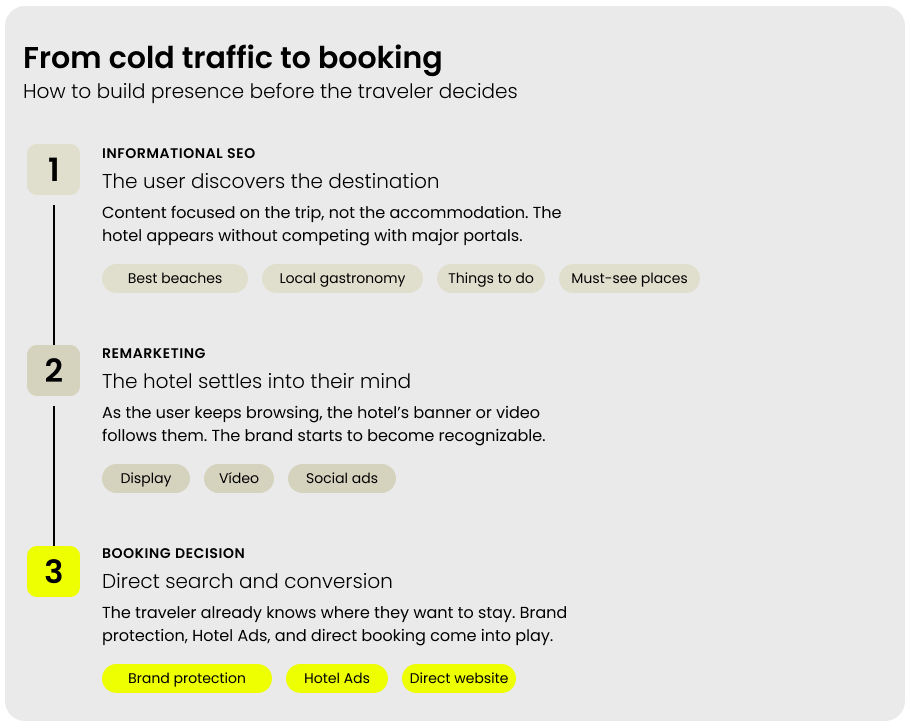
The most effective strategy involves working on informational content oriented: best beaches, local gastronomy, what to do, essential places. This content attracts users who are not yet looking for hosting, but who already show interest in the destination.
The key is to combine that cold traffic with banner or video remarketing campaigns. When that user reaches the moment of deciding where to stay, the hotel is already in its head.
Video is no longer optional
Advertising platforms evolve into visual formats, and video leads that change. A banner on a web page competes with dozens of simultaneous stimuli. A well-produced video shows the real experience of the hotel: the environment, the facilities, the atmosphere.
In tourism, the purchase decision is directly linked to the experience that the traveler imagines that he will live. Video is the format that best translates that promise.
A campaign without video today is an incomplete campaign.
Conclusions
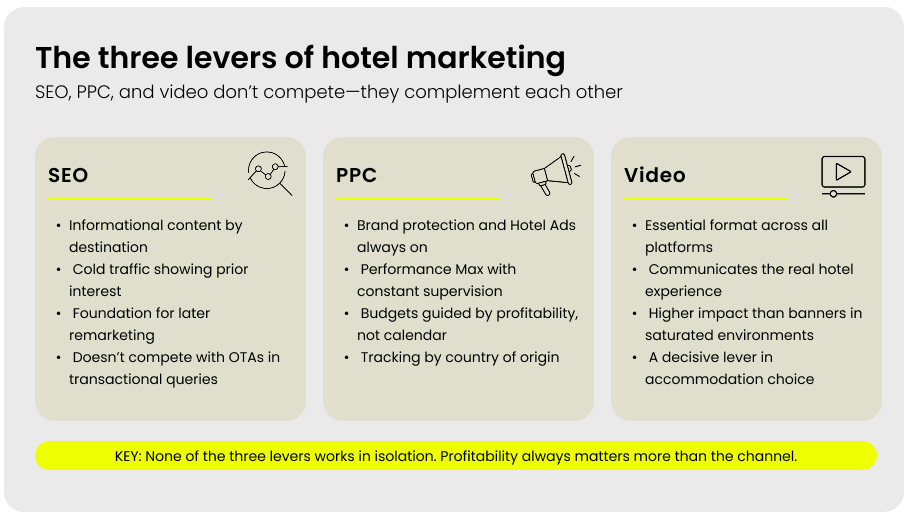
Managing campaigns for hotels is not a matter of turning on and off according to the calendar. It is understanding what works always, what responds to demand and what needs active supervision because the algorithm does not read the business.
Profitability rules. The video is no longer optional. And informational SEO well combined with remarketing is one of the most underrated strategies in the sector.
Do you want to review your hotel's campaign strategy?