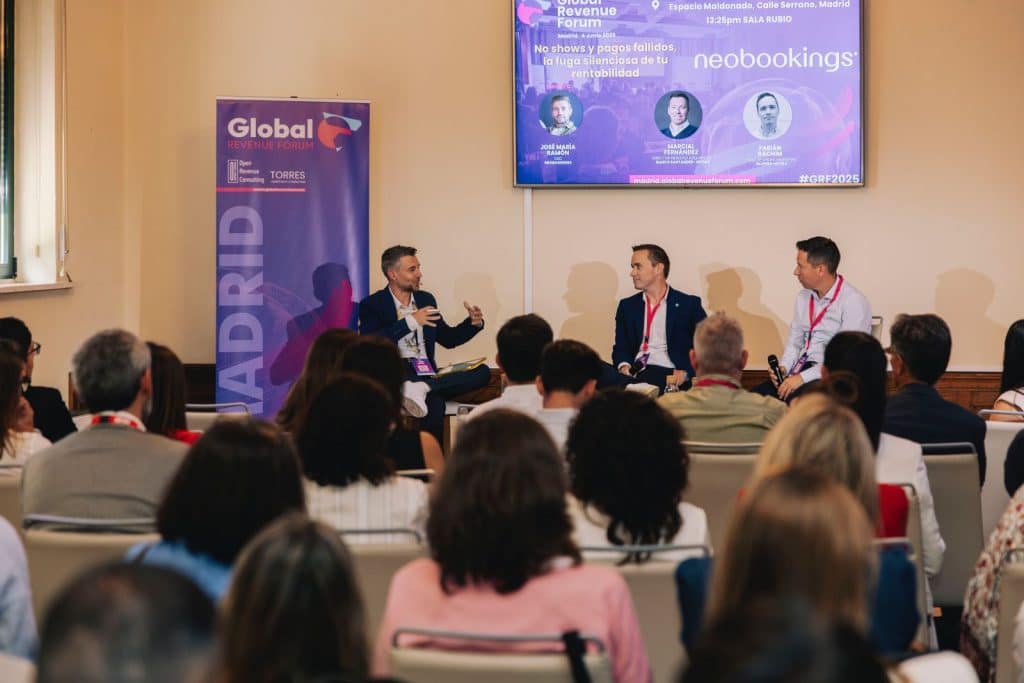

“When you handle 40,000 direct reservations a year, controlling one by one if the card is valid is simply impossible.” — commented Fabian Rassim

The problem is not new, but it remains unresolved in a structural way. In low season, a no-show can be acceptable. But “In July or August, not being presented with an eight-room reservation, it is a fairly large damage”.

"The hotelier does not know who to go to: to the bank, to the PMS, to the reservation engine? Everyone speaks their language"Jose Maria added. What seems like a technical issue is actually the symptom of an organizational disconnection: "We work for silos. I'm direct selling, I sell; the financier takes care of the financial part. But that no longer works. You have to work more coordinated".

Martial made it clear: “The real financial savings are not in renegotiating with the bank, but in automating the collection and using the final consumer card, not the OTA B2B”. The cost is reduced, the control improves and the disputes fall significantly when the holder of the reservation is the one who makes the payment.

And although the solution exists, many hotels are unaware of it. “Not everyone knows that this can be automated, that's why they still use B2B cards as the only salvation”Martial pointed out. But to do it, you have to go beyond the tools: "The solution is people. You have to talk between departments, understand each other".

The most revealing point came when Fabián acknowledged: “I prefer to have more cancellations, but make sure that the reservations I have are not going to cause problems”.

Direct sale is only profitable if it is well managed. Automating collections, validating cards and unifying the operations are not luxuries, they are minimum conditions to compete. As José María concluded, “It is not about waiting for the non-show, but about anticipating and avoiding it”.

In this context, solutions such as Neo Payments They allow to integrate collection management in a single system, with business logic and total traceability. But its impact depends on something deeper: review how direct sales are organized inside. It is not enough to have tools; You have to align them with processes and people. Because the risk is not in charging late, but in not knowing who should collect, how and when.