




Let me be direct: Your website and your booking engine are entering a radically different stage: that of their integration with AI environments and conversational agents.
The CRS will continue to be the operational heart of your hotel (d)at least for now), but one is coming revolution that it will not be a subject of embed apps on ChatGPT, not a booking Not of a more beautiful design, but of something much deeper: we go into the Was AGENTIC and the Design sentient.
For years, the hotel industry has been obsessed with conversion and friction. We have dissected every pixel from our booking pages: the button should be blue or green? Three steps or five? Do we show the total price from the beginning or do we gradually reveal it? We invest thousands of hours (and euros) in A/B tests, heat maps and behavior analysis to reduce every second of user doubt.
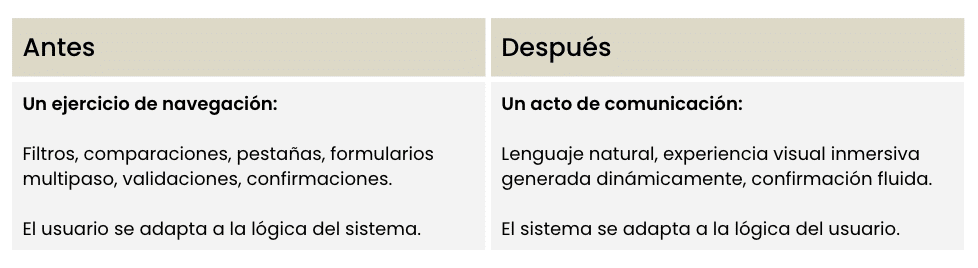
All that meticulous effort, all that conversion engineering, is becoming irrelevant at a dizzying speed. When the reservation occurs within a natural conversation, the forms simply disappear.
But it has not been in vain, all that accumulated knowledge about usability and human behavior is not lost: it will become the basis on which the new agent systems will learn and be trained.
The term may sound like science fiction, but it is a technological reality with specific applications. Sentient design (or Sentient Design) represents a paradigm shift in how we conceive of digital interfaces.
It is not about adding a chatbot to your website or implementing a more sophisticated recommendation system, but about something more interesting. The interfaces will cease to be static structures, to become adaptive environments, which will react organically to what your client wants.
Google is already exploring this concept publicly with Gemini, demonstrating that traditional interfaces have intrinsic limitations in a world where AI can natively understand intention, emotion, and context.
The ultimate goal: Create digital experiences that feel aware, anticipating what the person needs before it finishes expressing it.
In this new paradigm, AI agents will no longer be a complement to your interface: they will be the interface. They will be a new Frontend reserve, which will work radically different from all of the above.
But behind those agents there is still an operational brain: your CRS and your reserve engine, now converted into the nervous system that gives coherence and control to the entire experience.
Let's move this to the hotel world. Imagine this scenario, which will soon cease to be imaginary:
Phase 1: expressed intention
A user opens your platform and says (or writes):
“I need a hotel with sea views, a quiet atmosphere, a modern aesthetic and a good infinity pool.”
Phase 2: Reasoning on intention
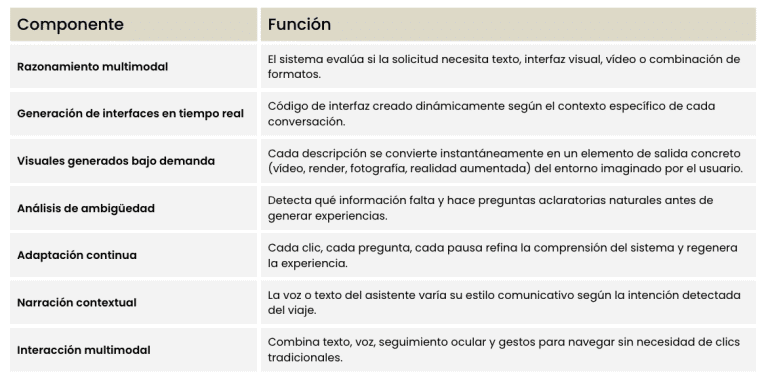
Here the system not only processes keywords. Execute a string of reasoning similar to Gemini:
- What kind of experience does this user need? Not looking for a list of 50 hotels. Needs visual inspiration and curated options.
- Is there enough information? Yes, but there is ambiguity: travel alone, in a couple, with family? What level of budget do you handle? You can ask clarifying questions or infer context of previous interactions.
- Which interface fits best? not a form. Not a standard list. An immersive experience that allows you to "feel" the environment before deciding.
Phase 3: Generation of visual experience
The system generates—in real time— a unique interface for this conversation:
- A 10-second immersive video that recreates the type of experience the user is imagining: the view from the room at dawn, the ambient sound of the waves, the sunset color palette from the terrace
- They are not stock images of your library. They are visualizations generated specifically for that conversation, combining elements of your real installations with the emotional context detected
- Full interface fits: Warm colors if you talk about relaxation, neutral tones for business trips, slow animations if you detect indecision
Phase 4: Adaptive interaction
Just as Gemini regenerates interfaces based on user actions, your agent responds to each interaction:
- The user clicks on the pool area: generates a detailed view with schedules, associated services, photos from different angles
- Ask for dining options: Create a visual experience with the restaurant, featured menus, reservation options
- Shows interest in activities: Generates a gallery interface with experiences available in the area
Each interaction refines the system's understanding of what the user is really looking for.
Phase 5: Invisible Transaction
While the user visually explores these generated options, the agent is working in the background: checking real availability, checking dynamic prices, updating inventory in your PMS, synchronizing with your channel manager, and preparing the payment agent.
When the user says "Like this", the reservation is practically completed. Only the final confirmation is missing.
1. Sentient reserve engines
You no longer have a booking page, but a set of agents that generate unique experiences for each conversation.
A user interested in a romantic weekend does not see the same interface as someone who seeks to disconnect due to stress. Not because you have two scheduled versions, but because the system generates the optimal experience for each case.
2. Immersive planning assistants
As in the Gemini example with the birthday party, a user can say "I want to organize a very intimate wedding in your facilities" and the system generates a complete interface with options of spaces, catering, decoration, schedule.
All personalized, all generated at that time.
3. Exploratory experiences without fixed structure
The user can freely navigate: “Show me breakfast options with views”, “What is the spa at night”, “What activities are near the hotel”. Each request generates a new interface optimized for that specific type of information.
The system decides which format works best in each case.
4. Interactive physical spaces
Screens in your lobby where visitors verbally describe their ideal stay and the environment responds visually, generating immersive scenes of your hotel adapted to what they are imagining.
The line between digital and physical fades.
The irony of all this is that, after years building increasingly rigid systems to manage the complexity of the reserve, we are returning to the simplest of human beings: language, conversation.
But not just any conversation, but a backed by systems that understand natural language, reason about ambiguous intentions, generate user interfaces on the go, create visual content in real time, manage dynamic availability, process payments safely and keep all your systems in sync Operations… All while the user simply talks.
It is not that the complexity disappears, but that it moves: from the user to the system, from the interface to the intelligence, from the predefined design to adaptive reasoning.
I know it sounds like science fiction, but Gemini's demos are real and are now publicly available. Models like Claude, ChatGPT or Gemini itself can already have complex natural conversations and reason about what kind of experience each user needs.
Systems like Dall-E, Midjourney, Stable Diffusion, Sora, etc. They already generate professional quality videos and images from textual descriptions and material from your hotel.
If you have followed our previous articles on MCP (Model Context Protocol) and MCP Neobookings, You're probably starting to see how all the puzzle pieces fit.
MCP allows AI agents to directly access your operating systems: your PMS, your fare engine, your inventory, your CRM. Something for which we are already ready in neobookings.
Now add to this equation the Sentient design: Agents capable of generating dynamic interfaces, reasoning about ambiguous intentions and creating personalized visual experiences on the go.
We are not speculating about the future, we are describing a present that has not yet been massively distributed.
Are you preparing?